
The Professional Turf Cleaning Process
The full job workflow pros run, from inspection and debris removal to sanitizing, grooming, infill top-off, and compliant wastewater handling.
Why a Repeatable Process Is the Whole Business
Every profitable turf-cleaning business runs on one thing a homeowner with a hose will never have: a repeatable standard operating procedure. The difference between a $299 Refresh and a $699 Deep is not luck or a secret chemical.
It is a named, ordered sequence that scopes the work, prices it correctly, drives product into the infill where contamination actually lives, respects label dwell time, and handles wash water without inviting a stormwater fine. This chapter lays that SOP out stage by stage so any technician on your crew can execute it the same way on every property.
The core mental model to carry through the whole chapter: turf does not biologically self-clean the way soil does. Infill is an inert, porous matrix where urine salts, fecal organics, and moisture accumulate and feed bacterial biofilm bonded to the infill granules and the latex or polyurethane backing.
That is why a plain water rinse fails as a cleaning method. Water carries no kill claim, delivers no lethal contact time, cannot reach biofilm, and simply dilutes and redistributes contamination while leaving the urine salts behind to re-odorize the moment the surface dries.
Your SOP exists to solve the problem rinsing cannot.
We will move through the full process: walk-and-inspect, dry debris and waste removal, the deep-clean deodorizing step (where chemistry choice and TurfMist live), dwell time, power brooming and de-compaction, optional infill top-off, and final rinse with compliant wash-water management.
Along the way you get real 2025 to 2026 pricing ranges, a frequency rule of thumb, the enzyme-versus-peroxide tradeoff that decides which product you reach for, the EPA-label and Clean Water Act facts that keep you legal, and an honest cost-per-job economic model for running a hydrogen-peroxide odor system on client jobs at scale.
If you want to see exactly what this premium buys versus a DIY approach, contrast it against the homeowner DIY-versus-pro chapter.
The 6-Stage Professional SOP
Lay the full sequence out as a named, ordered process you can pin to a clipboard: Inspect, then Dry Debris and Waste Removal, then Deep Clean (apply deodorizer or sanitizer), then Dwell, then Power-Broom and Groom (with de-compaction as needed), then Infill Top-off (as needed), then Final Rinse, then Wash-Water Management.
Professional turf cleaning commonly runs 4 to 6 documented steps. The value is that it is repeatable, not improvised. Every technician executes the same order on every job.
State the four defining pro-versus-DIY differences up front, because they are what your customer is paying for:
- Commercial sprayers that drive product into the infill and backing layer where contamination lives.
- Respecting label dwell times instead of spraying and immediately rinsing.
- Power brooming instead of a hand broom.
- Proper wash-water handling under local stormwater rules.
Frame the SOP as both a quality system and a pricing system. The inspection scopes the quote, and the deep-clean, infill, and reclamation steps are what justify moving a job from a $299 Refresh up to a $699 Deep.
One honesty note for your own planning: crew size and time-per-job are not standardized industry figures. If you build them into your estimates, treat them as rough operational numbers for your own shop, not published facts.
Did You Know
Print this SOP as a one-page field checklist for every truck. Consistency across technicians is what lets you guarantee results and defend your pricing. For the tools each stage runs on, see our turf cleaning equipment list.
Stage 1: Walk-and-Inspect, the Step That Scopes the Quote
The inspection is not a formality. It is where the job gets scoped and priced, so slow down and read the turf. Work through a fixed checklist on every property:
- Drainage flow first. Water should move through the backing, not pool. Poor drainage is what lets turf stay chronically damp, which favors mold, Giardia cyst persistence, and Leptospira survival.
- Seams and lifting. Inspect seams for separation or lifting, and identify matted or flattened high-traffic lanes where fibers lie flat instead of standing.
- Pet hot-spots. A $10 to $20 UV blacklight reveals urine zones that are invisible in daylight, letting you target deep-clean passes instead of guessing.
- Infill depth. Healthy fibers stand up. Fibers lying flat signal compacted or displaced infill that may need de-compaction or a top-off.
- Burns, stains, and heat-glaze damage. Document them as part of scoping, the same way the stain-removal chapter approaches them. Turf surfaces commonly reach about 140 to 170F on hot sunny days (extremes recorded to roughly 180F and above), about 35 to 55F hotter than adjacent natural grass, which is both a job hazard and a damage source.
The inspection output is the scope and the quote. It tells you whether this is a Refresh (light maintenance), a Restore (pet and odor work), or a Deep (urine extraction and infill restoration), and therefore which price tier applies.
Pro Tip
Hand the customer the blacklight findings. Showing them the hidden urine zones converts inspections into higher-tier deep-clean jobs and sets honest expectations about recurrence.
Stage 2: Dry Debris and Solid Waste Removal, Always First
Physically remove solid waste and debris before any product touches the turf. This is non-negotiable for two reasons: organic load shields organisms and inactivates many disinfectants, which is precisely why product labels require pre-cleaning.
Pooled urine should be rinsed or blotted before the deep-clean step so the oxidizer or enzyme is not spent on surface debris instead of the infill where odor lives.
Skipping pre-removal is a top failure mode. No disinfectant reliably penetrates a fecal mass, and a deodorizer applied over debris is wasted product and a callback waiting to happen.
Dry debris removal of leaves, hair, and fine litter also prevents that organic matter from trapping moisture and feeding biofilm between services.
Warning
Deodorized is not disinfected, and masking ammonia odor does not reduce pathogen load. Physical removal of waste is the only step that actually lowers the organic and pathogen burden before chemistry does its job.
Stage 3: The Deep Clean, Where Chemistry Choice Is the Whole Game
This is the deodorizer and sanitizer application step, and the centerpiece is the enzyme-versus-peroxide tradeoff. A pro picks based on whether odor is fresh or set-in, and sometimes layers both.
For a deeper treatment of saturation technique and the deodorizing chemistry, cross-reference the homeowner deep-cleaning chapter and, for set-in uric-acid odor specifically, the pet-odor-control chapter.
Understand the odor chemistry so you can explain it to a customer. Fresh urine is roughly 95% water plus urea and is nearly odorless.
Within hours to days, urease-producing bacteria convert urea to ammonia and push local pH toward 8 to 9, which is the sharp smell.
Over days, uric acid dries into water-insoluble urate crystals bonded to the infill that reactivate with heat and humidity, potentially for years.
Bio-enzyme cleaners
Bio-enzyme cleaners hydrolyze uric-acid crystals and organic urine residues over roughly hours to a few days and penetrate the backing where urine soaks in. They are the right choice for set-in pet odor, because uric acid is not water-soluble and re-crystallizes with humidity.
The honest critique is that they are slow, moisture-dependent, and temperature-fussy, and may need repeat applications. That is a tradeoff, not a reason to call them useless.
Oxidizing hydrogen-peroxide cleaners
Oxidizing hydrogen-peroxide cleaners break down organic odor compounds and the biofilm responsible for ammonia smell, then decompose to water and oxygen, leaving no chemical residue.
They act fast on fresh surface messes and routine deodorizing but may not penetrate deeply set-in urine, a tradeoff the peroxide vendor itself acknowledges.
Be precise about how peroxide works, because this is where most marketing overreaches. It kills the ammonifying bacteria on contact and oxidizes organic waste. It does not meaningfully oxidize uric-acid crystals at room temperature on its own.
In effective turf formulas, crystal removal comes from the combination of peroxide plus mildly acidic pH and surfactants or wetting agents that dissolve and lift the urate residue and carry it into the infill, alongside generous saturation, dwell time, and agitation.
Tell the customer the product breaks down bacteria and organic waste and helps dissolve and lift uric-acid residue. Never tell them peroxide alone destroys the crystals.
Whichever product you reach for, saturate until the infill is visibly wet, then broom it in. Under-application is the leading reason treatment fails, because the crystals live in the infill and backing, not on the fiber surface.
For high-risk multi-dog or kennel situations, an EPA-registered disinfectant used at its labeled dilution and contact time is the tool for hardy pathogens like parvovirus and Giardia.
Read the EPA registration number and label for the specific pathogen and the separate, often longer parvovirus contact time, rather than trusting a generic 99.9% headline.
Recommended Product
TurfMist is the recommended fast-acting oxidizing option for this step. As a ready-to-use, hydrogen-peroxide-based, pet-safe odor eliminator, it handles routine deodorizing and fresh pet messes, oxidizing the odor source instead of masking it and leaving no residue. For deeply set-in urine, pair the oxidizer knockdown with enzymes or zeolite for long-term control.
Stage 4: Dwell Time, the Hero Variable
Treat dwell time as the hero variable, not a formality. A product only works while the surface stays wet for its full labeled dwell time.
Rinse too early and you wash product off before it acts. Let it flash-dry in the heat and neither enzymes nor peroxide do their job.
Disinfectant contact times commonly run 30 seconds to 10 minutes depending on product and pathogen.
Parvovirus virucides often need the longer end, around 10 minutes, while accelerated hydrogen peroxide products can carry 30-second-to-1-minute general claims. Always follow the specific EPA label, never a generic number.
Heat defeats dwell time. On warm or windy days a sprayed surface can dry before the contact time elapses, voiding disinfection. Apply in shade or evening and pre-rinse to cool a baking surface.
This is one more reason to plan jobs around the surface-temperature realities covered in the seasonal-care chapter. Specific deodorizing timings vary by product, so the field rule is simple: follow the label. For the recommended peroxide system, the manufacturer states roughly a 15-minute window once dry for pet re-entry, with full air-dry typically 2 to 6 hours depending on heat and humidity.
Never overstate timing in customer-facing materials. Do not promise full odor elimination in a fixed window. Honest dwell guidance protects you from callbacks.
Warning
Spraying and immediately rinsing, or letting product bake dry in full sun, is the single most common reason a professional treatment fails. The chemistry is only as good as the dwell time you actually deliver.
Stage 5: Power Brooming and Mechanical De-Compaction
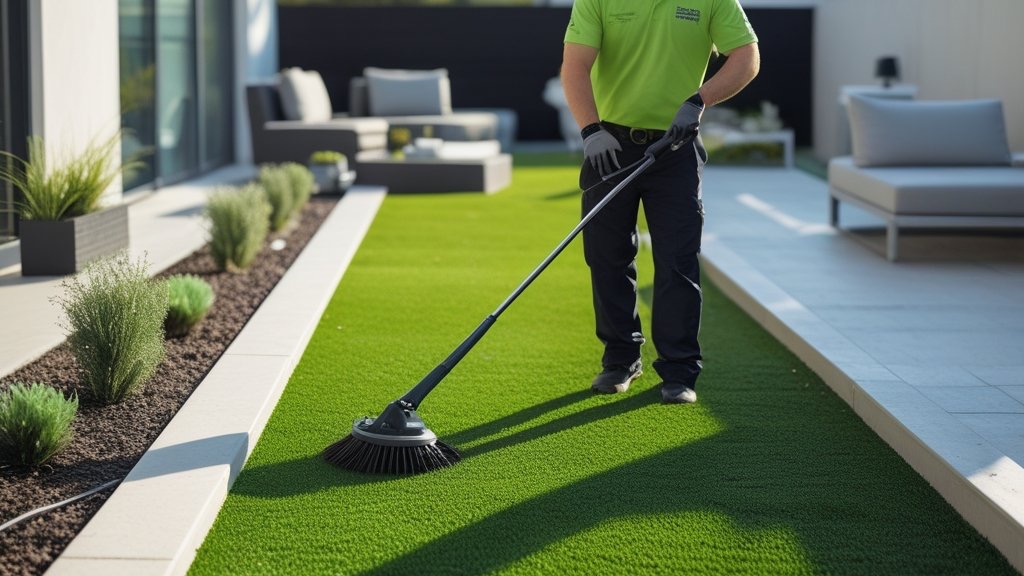
Power brooming is the defining pro-versus-DIY capability. It lifts the pile and drives product and infill down toward the backing where contamination sits. A hand broom cannot do this.
Pair power brooming with mechanical de-compaction wherever infill has hardened, especially on athletic and high-wear turf, to break up compacted granules before re-leveling.
This step is why a hose rinse alone never truly cleans turf. Water without agitation and product just redistributes contamination and leaves infill compacted.
Brooming the deep-clean product into the infill during or right after the dwell window is what carries the active chemistry to the crystals and biofilm, not just the visible fibers.
De-compaction also restores drainage and helps the surface dry between uses, which is itself a real, low-cost public-health control because Giardia cysts and Leptospira are desiccation-sensitive.
Pro Tip
A battery backpack sprayer for product plus a power broom is the minimum equipment pairing that separates a professional job from a homeowner with a hose. This is the capability customers are actually paying the premium for. See the tools-and-products chapter for the full kit, and Pro Equipment and Machines for buy-versus-rent guidance.
Stage 6: Infill Top-Off and Redistribution
Be honest about when infill work is needed. Most residential lawns rarely need new infill. Top-off matters most on athletic and high-wear turf, and for odor control via a zeolite top-dress.
Do not upsell sand onto a residential lawn that does not need it. The sequence within this step is de-compact, decontaminate, then re-level.
Redistribution evens out displaced infill in high-traffic lanes so fibers stand again.
Total infill load runs roughly 1 to 3 lb per sq ft depending on pile height and use, toward the high end on sports turf. Always defer to the turf manufacturer's spec rather than a generic number.
Zeolite is a common odor-control infill, commonly applied around 1 lb per sq ft as a top-dress. It binds ammonium and ammonia via cation exchange to suppress odor, and periodic rinsing helps maintain its capacity.
Vendor figures put its absorption around 81% of its weight in water and roughly 55% in urine, but present those as single-vendor claims, not verified facts.
Keep two distinctions clear. Zeolite is an adsorbent companion that traps odor molecules between treatments. It is not a substitute for breaking down the odor source with the deep-clean step.
Antimicrobial-coated infills are marketed to slow surface bacterial regrowth and reduce odor over time, but they are a supplement, not a substitute for waste removal and periodic disinfection. Avoid quoting marketing percentages as substantiated.
Did You Know
Infill economics for context: infill material runs roughly $0.50 to $1.75 per sq ft (sand low, rubber or pet-grade higher), plus labor. That is still far below full turf replacement at roughly $12 to $22 per sq ft installed, which is the honest fallback when infill is saturated beyond cleaning.
Stage 7: Final Rinse and Wash-Water Management
Treat wash water as a compliance issue, not an afterthought. The Clean Water Act and NPDES program, along with local MS4 stormwater ordinances, generally prohibit discharging pollutant-laden water to storm drains or waterways without authorization.
Avoid absolute federal-permit language, though. Enforcement is primarily through local and state stormwater rules that vary by city and state.
The practical message is to check your local requirements before the first job in a new jurisdiction.
Teach your crew three compliant disposal options:
- Water reclamation or vacuum recovery to a waste tank.
- Berm-and-evaporate, containing the runoff on site.
- Sanitary-sewer discharge with municipal pretreatment approval.
A plain-water rinse using a biodegradable, pet-safe product is lower-risk, but it is not automatically exempt. Local rules still govern where that water can go.
Vacuum and water reclamation is itself a pro differentiator and a sales point. It lets you work in jurisdictions and on commercial sites where uncontrolled discharge would be a violation.
Never let detergent or contaminant-laden wash water run into a storm drain. The downside is real fines and reputational damage that dwarf the cost of a recovery tank.
Warning
When using the recommended peroxide system, no rinse is required per the manufacturer's instructions, which simplifies wash-water management on light-maintenance visits. When you do rinse after heavier deep cleans, the local stormwater rules still apply to that runoff.
The SOP as a Numbered Field Sequence
Here is the same process condensed into the seven moves a technician runs on every property. This is the version that belongs laminated in the truck.
Walk-and-inspect, then quote from findings
Check drainage flow, seams, matted high-traffic lanes, pet hot-spots (use a $10 to $20 UV blacklight), infill depth (fibers should stand, not lie flat), and any burns or stains.
The findings determine the price tier (Refresh from $299, Restore from $399, Deep from $699) and whether infill work is needed.
Remove dry debris and solid waste first
Physically pick up all solid waste and debris and rinse or blot pooled urine before any product is applied.
Organic load shields organisms and inactivates disinfectants, which is why labels require pre-cleaning. This is the only step that actually lowers the pathogen and organic burden.
Apply the deep-clean deodorizer matched to the odor
For fresh messes and routine deodorizing, apply the fast-acting hydrogen-peroxide oxidizer (TurfMist, ready-to-use, sprayer 6 to 8 inches from the surface to a light even dampening).
For deeply set-in uric-acid odor, use a bio-enzyme cleaner or layer the oxidizer knockdown with enzymes or zeolite. Saturate until the infill is visibly wet, not just the fibers.
Respect the label dwell time
Keep the surface wet for the full labeled contact time. Work in shade or evening and pre-rinse to cool a baking surface so product does not flash-dry.
Follow the specific product label. For the peroxide system, expect about 15 minutes to pet-safe once dry and 2 to 6 hours full air-dry.
Power-broom and de-compact
Power-broom to lift the pile and drive product and infill toward the backing where contamination lives.
Pair with mechanical de-compaction wherever infill has hardened, especially on athletic and high-wear turf. This agitation is what makes the chemistry reach the crystals and biofilm.
Top off and redistribute infill only as needed
On athletic and high-wear turf, or for odor control, de-compact, decontaminate, then re-level infill.
Total load runs about 1 to 3 lb per sq ft per the turf manufacturer's spec, and a zeolite odor-control top-dress is commonly about 1 lb per sq ft. Skip new infill on residential lawns that do not need it.
Final rinse and manage wash water compliantly
Where a rinse is used, manage the runoff under local stormwater rules: vacuum or water reclamation to a waste tank, berm-and-evaporate, or sanitary-sewer discharge with municipal approval.
Never send contaminant-laden water to a storm drain. Check local requirements before working in a new jurisdiction.
Pricing and Frequency Field Reference
Use these ranges to quote and to sanity-check what you are charging. Build a proper bid on top of them in the pricing-and-bidding chapter.
- Residential tiers (Sparkly Turf rate card): Refresh from $299, Restore from $399, Deep from $699. The starting price is the floor for jobs up to 400 sqft; above 400 sqft, add $0.75/sqft (Refresh/Restore) or $0.95/sqft (Deep) for the extra area.
- Market note: these are real rates from a premium, pet-heavy Las Vegas market. Lower-cost or low-pet markets run under this, so adjust the dollar figures to your own market while keeping the tier structure.
- Job totals: pet-odor full-detail work starts at the Restore tier ($399) and rises to Deep ($699) for set-in urine. Commercial and sports-field jobs run $500 to $2,500 and beyond.
For frequency, present a vendor guideline rather than an industry standard: yearly with no pets, about every 6 months with 1 to 2 dogs, and quarterly for 3 or more pets or high traffic. Actual frequency depends on pet load, climate, and use.
Use the per-sq-ft tiers plus the frequency guideline together to build recurring-maintenance contracts, which is where turf-cleaning businesses earn predictable revenue rather than one-off deep cleans.
Position TurfMist and a light power-broom as the between-service maintenance layer described in the homeowner routine-maintenance chapter.
Set honest expectations in the quote. No single product permanently eliminates set-in pet odor. Because uric acid is not water-soluble and re-crystallizes with humidity, odor control is a recurring maintenance cycle, especially with multiple pets.
Pro Tip
Anchor your quote to the inspection findings, not a flat rate. A blacklight-documented multi-pet hot-spot justifies the enzyme deep-clean tier and a quarterly contract, both more profitable and more honest than a one-time basic rinse.
Running TurfMist on Client Jobs: Cost-Per-Job Economics
TurfMist is a ready-to-use, hydrogen-peroxide-based, pet-safe odor eliminator made in Las Vegas, Nevada, sold in 1-gallon, 4-pack, 12-pack, and 55-gallon drum formats with a Pro Login and bulk or wholesale positioning for installers, kennels, and commercial pet facilities. It is ready-to-use with no mixing or dilution.
Per the manufacturer, hold the sprayer 6 to 8 inches from the surface and spray evenly until lightly dampened, with no rinsing required.
Pros can run a battery backpack sprayer or fogger to cover large installs fast. Apply it ready-to-use, since no pro dilution ratio is published.
Manufacturer-stated coverage is 400 to 600 sq ft per gallon at a light-maintenance rate. Heavily contaminated areas will use more per square foot, which matters for your cost math.
Pricing as of June 2026 (confirm at purchase) is $47.99 for 1 gallon and $447.99 for the 12-pack, which works out to about $37.33 per gallon.
That puts chemical cost for a typical 300 to 500 sq ft light-maintenance visit at roughly $37 to $48 in product, well under $50 per visit at 12-pack pricing. The 55-gallon drum lowers per-job cost further for high-volume installers, though there is no verifiable drum price to quote here.
On re-entry, the surface is pet-safe once dry, about 15 minutes, with full air-dry typically 2 to 6 hours depending on heat and humidity. Keep pets off while it is still wet, since wet hydrogen peroxide can irritate skin, eyes, and paws.
Position TurfMist as the maintenance layer, not a replacement for the mechanical work. It does not replace power brooming, infill top-off, or wash-water reclamation, and deeply set-in urine may still need enzyme action, zeolite, or repeat applications.
One compliance and marketing guardrail to hold firmly: TurfMist's 99.9% figures are the manufacturer's own marketing and efficacy claims, and no EPA registration number is published on the site.
Do not present it as a certified disinfectant or sanitizer in a regulatory sense, and do not position it as a parvovirus or Giardia disinfectant. For comparison, the same-chemistry competitor OxyTurf claims a 6% stabilized peroxide solution and EPA registration.
TurfMist's wedge is the clean bulk and wholesale ladder, made-in-USA Nevada production, and a ready-to-use format that scales from homeowner to pro volume.
Recommended Product
For a cleaning company, TurfMist's value is a single recommended odor system across every job. Ready-to-use means no mixing errors on a crew, about $37 per gallon at 12-pack pricing keeps cost-per-job under $50 for a standard yard, and the roughly 15-minute pet re-entry window lets you hand the property back fast. Pair it with power brooming and, for set-in cases, enzymes or zeolite.
Top Field Pitfalls That Cause Callbacks
Every item here is a callback, a refund, or a liability event. Building the SOP to avoid them is cheaper than fixing them after the customer is already unhappy.
- Treating dwell time as optional. Rinsing too early or letting product flash-dry in heat means neither enzymes nor peroxide actually work.
- Assuming hydrogen peroxide fixes deeply set-in urine. It oxidizes surface odor fast but may not penetrate uric-acid crystals soaked into the backing. That is an enzyme or zeolite job.
- Believing a hose rinse alone cleans turf. Water without agitation and product redistributes contamination and leaves infill compacted.
- Skipping wash-water rules. Letting contaminant-laden water reach a storm drain risks Clean Water Act, NPDES, and local fines.
- Over-applying infill or using the wrong type. Dumping sand on a residential lawn instead of a targeted zeolite top-dress for odor wastes product and money.
- Using harsh chlorine or high-strength bleach. It can damage fibers, harm pets, and kill surrounding plants. Never mix bleach with pet urine or ammonia (chloramine gas) or with peroxide products.
- Power-washing at too-high PSI too close to the turf. This can displace infill, fray fibers, or tear seams.
- Cleaning at peak heat when the surface exceeds 150F. It flash-dries product and endangers technicians and pets.
- Marketing permanent odor elimination from any single product. Odor control is a maintenance cycle, not a one-time fix, especially with multiple pets.
Warning
Every item on this list is a callback, a refund, or a liability event. Building the SOP to avoid them is cheaper than fixing them after the customer is already unhappy.
Frequently Asked Questions
A repeatable SOP of 4 to 6 stages: (1) walk-and-inspect, (2) dry debris and solid-waste removal, (3) deep clean with a deodorizer or sanitizer applied at its label dwell time, (4) power-broom and groom with mechanical de-compaction as needed, (5) optional infill top-off or redistribution, and (6) final rinse with wash-water management. The defining pro differences are commercial sprayers that reach the infill layer, respecting dwell times, power brooming instead of a hand broom, and proper wash-water handling under local stormwater rules.
Real published residential pricing uses named tiers with a starting-price floor. The Sparkly Turf rate card runs Refresh from $299 (light maintenance), Restore from $399 (the pet and odor tier), and Deep from $699 (urine extraction and full restoration), with $0.75/sqft (Refresh/Restore) or $0.95/sqft (Deep) added only to area over 400 sqft. So a job at or under 400 sqft pays the tier starting price; a 1,000 sqft Restore is $399 + (600 x $0.75) = $849. Pet-odor full-detail work starts at the Restore tier ($399), and commercial or sports-field jobs run $500 to $2,500 and beyond. These are real rates from a premium, pet-heavy Las Vegas market; treat them as a high-cost-market reference, not a universal guarantee.
A common vendor rule of thumb (a guideline, not an industry standard) is yearly with no pets, about every 6 months with 1 to 2 dogs, and quarterly for 3 or more pets or high traffic. Actual frequency depends on pet load, climate, and use. Because uric acid is not water-soluble and re-crystallizes with humidity, odor control is a recurring maintenance cycle, which is why recurring-service contracts make sense for pet households.
Artificial turf does not biologically self-clean like soil. Infill is an inert, porous matrix where urine salts, fecal organics, and moisture accumulate and feed bacterial biofilm bonded to the granules and the latex or polyurethane backing. Water carries no kill claim, delivers no lethal contact time, cannot reach that biofilm, and simply dilutes and redistributes contamination while leaving urine salts behind. Without agitation and the right product, a rinse also leaves the infill compacted.
It depends on whether the odor is fresh or set-in. Hydrogen-peroxide oxidizers (like TurfMist) act fast on fresh messes and routine deodorizing, killing the ammonifying bacteria on contact and breaking down organic waste with no residue, but they may not penetrate deeply set-in urine. Bio-enzyme cleaners hydrolyze uric-acid crystals over hours to a few days and reach the backing where urine soaks in, making them the right tool for set-in pet odor. A thorough pro job often layers them: an oxidizer pass for immediate knockdown, then enzymes or zeolite for long-term control.
Generally no. The Clean Water Act and NPDES program, along with local MS4 stormwater ordinances, typically prohibit discharging pollutant-laden water to storm drains or waterways without authorization, though enforcement is mostly through local and state rules that vary by city and state. Compliant options are vacuum or water reclamation to a waste tank, berm-and-evaporate, or discharge to the sanitary sewer with municipal approval. A plain-water rinse with a biodegradable, pet-safe product is lower-risk but not automatically exempt. Check your local requirements before working in a new jurisdiction.
At 12-pack pricing of $447.99 (about $37.33 per gallon) and manufacturer-stated coverage of 400 to 600 sq ft per gallon, a typical 300 to 500 sq ft light-maintenance visit uses roughly one gallon, so product cost lands around $37 to $48 per visit, well under $50. A single gallon retails at $47.99, and a 55-gallon drum lowers per-job cost further for high-volume installers and kennels. It is ready-to-use (no mixing), applied via pump, backpack sprayer, or fogger, with pets back on the turf about 15 minutes after it dries. Heavily soiled yards use more than a gallon, so budget accordingly.
Not as a substitute for an EPA-registered disinfectant. Parvovirus is highly environmentally stable and usually needs a virucidal product (sodium hypochlorite is most reliable) at adequate contact time, and Giardia cysts need specific inactivation conditions. TurfMist publishes no EPA registration number, so position it as odor elimination and routine sanitation, not a certified disinfectant. For high-risk multi-dog or kennel settings, use an EPA-registered product at its labeled dilution and contact time, and remember to remove solid waste first since organic load inactivates disinfectants.
Liked this chapter? The handbook includes:
Bonus resources that go with what you just read
- Per-visit standard operating procedure checklist
- Job inspection and condition-report template
- Wastewater and runoff compliance quick reference
Free Turf Cleaning Cheat Sheet
Get a quick-reference cleaning schedule, product list, and seasonal checklist delivered to your inbox.
You're on the list!
Check your inbox for the cheat sheet.
Something went wrong. Please try again.
No spam, ever. Unsubscribe anytime.
Get the Complete Turf Cleaning Handbook
All 8 chapters, bonus checklists, seasonal schedules, and product recommendations in a beautifully designed, downloadable PDF.
Buy the HandbookInstant download. 30-day money-back guarantee.