
Commercial & Specialty Turf Jobs
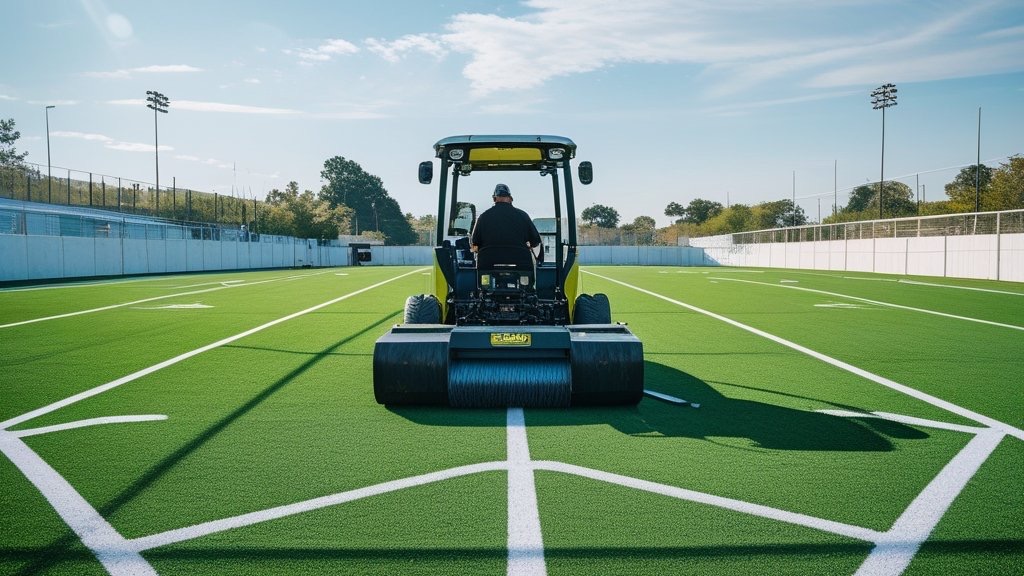
Sports fields, putting greens, playgrounds, gyms, rooftops, and dog daycares. The methods, frequencies, and contracts behind high-value work.
Why Commercial Work Is the High-Margin Tier
Commercial and specialty turf work is where a turf-cleaning company stops trading hours for one-off residential jobs and starts building recurring contract revenue. The same power broom and sprayer that clean a backyard can clean a dog daycare, a rooftop event lawn, or a fitness studio, but the buyer, the standard, the liability, and the price are completely different.
This chapter maps the commercial landscape by the one variable that actually drives method, equipment, and pricing: the governing standard. Sports fields answer to GMAX impact-safety testing (ASTM F1936). Playgrounds answer to ASTM F1292 fall-height and ADA accessibility rules. Gyms, pet facilities, and vet clinics answer to sanitation and odor-control expectations.
The standard dictates what you do, what gear you need, and what you can charge.
The economics reward the move. Commercial cleaning typically runs higher per square foot than residential, jobs are larger, and the best segments renew on a schedule instead of waiting for the phone to ring.
Pet facilities in particular are the highest-frequency recurring revenue in the trade, with staff hose-downs daily and a professional deep deodorize and sanitize every one to four weeks. That cadence is exactly where a hydrogen-peroxide odor system like TurfMist earns its place: applied between staff cleanings as the routine odor-control and surface-sanitizing layer, priced cheaply enough per gallon to protect margin on a recurring contract.
This chapter is deliberately honest about scope. Some commercial work, like GMAX-relevant infill management on a sports field or fall-height and ADA compliance on a playground, is mechanical and structural, and no spray product touches it.
Knowing where odor chemistry helps and where it has no role is part of what separates a credible commercial bidder from a residential cleaner quoting out of their depth. The full job sequence that underlies every one of these segments lives in the Professional Turf Cleaning Process chapter; this chapter layers the segment-specific standards and contract angles on top of it.
Segment the Market by Liability and Standard, Not Just by Surface
The single most useful way to think about commercial turf is by the standard that governs it, because the standard dictates the method, the equipment, and the price. There are three broad buckets, and every commercial inquiry you take falls into one of them.
- Sports fields are governed by GMAX impact-attenuation testing under ASTM F1936. The maximum allowable GMAX is 200, and biomechanical data ties values above 200 to a sharp rise in life-threatening head-injury risk. The Synthetic Turf Council and NFL guidance recommend keeping all test locations below roughly 165 G's as a safety margin.
- Playgrounds are governed by ASTM F1292, which requires surfaces to keep GMAX under 200 AND HIC (Head Injury Criterion) under 1,000 at the certified critical fall height, plus ADA accessibility: firm, stable, slip-resistant surfaces.
- Gyms, pet facilities, and vet clinics are governed by sanitation: pathogen control and odor control. These are sanitation contracts, not grooming contracts, and they are where odor chemistry like TurfMist fits.
The reason this matters is that the standard tells you whether the job is mechanical (infill, grooming, fall-height) or chemical (deodorize, sanitize).
Quoting the wrong work for the standard is how bids get lost and how liability gets created. Lead every commercial walkthrough by identifying the bucket before you price anything.
Sports Fields: Cleaning Is Really Infill Management
Sports-field cleaning is fundamentally infill management, not cosmetics. Brushing and grooming keep fibers upright, mechanical de-compaction loosens the matted infill layer, and redistribution evens out high-traffic zones like goal mouths and hash marks.
This is safety-relevant work. Compacted or displaced and thinned infill raises GMAX, and a field that drifts over the 200 fail threshold creates injury liability. Crews must understand they are doing a safety service, not fluffing fibers.
The GMAX test itself (ASTM F355 Procedure A / F1936) drops a roughly 20 lb missile fitted with an accelerometer from 24 inches (2 feet), three drops at each of ten field locations, and the peak deceleration in g-units is the GMAX value.
Pair your routine grooming with annual third-party GMAX testing. The pass threshold is 200; the target to aim for is below 165.
Price the field work realistically and keep cleaning separate from capital restoration.
- Full-size synthetic sports-field annual maintenance commonly runs roughly $5,000 to $15,000, with broader published estimates up to about $23,000, varying widely by field size, usage, and climate. Treat these as rough, source-dependent ranges that vary by field, not fixed rates.
- Re-infill or restoration is a separate capital cost (roughly $6 to $10 per square foot per cited estimates), not routine cleaning. Confusing restoration with grooming is how crews misprice and lose money on either end.
TurfMist has no role on a sports field. GMAX testing, infill redistribution, and grooming are mechanical and structural, so never imply an odor spray affects a field's safety ratings.
The power brooms, groomers, and de-compaction equipment this work demands are covered in the Pro Equipment & Machines chapter.
Warning
Liability trap: Treating sports-field grooming as cosmetic is dangerous. Displaced or compacted infill raises GMAX and can push a field over the 200 fail threshold. Coordinate maintenance with scheduled GMAX testing and document it every visit.
Golf Putting Greens: A Precision Job
Synthetic putting greens are a precision maintenance job centered on grain control and ball roll. Brush against the grain roughly every two weeks, and more often in high-traffic areas, to control grain and keep ball roll consistent.
Periodically check and re-level the sand infill, and deep clean at least annually. Over-watering and harsh detergents are the two main ways crews damage a green, so keep water moderate and chemistry gentle.
Treat any fixed top-dress or infill-check cadence as a vendor recommendation that varies by product and use, not a hard standard.
When you build the bid, position the green as a recurring precision-service line rather than a one-time clean, because consistent ball roll is the deliverable the client actually pays to protect.
Pro Tip
Over-watering and harsh detergents ruin more synthetic greens than wear does. When in doubt, brush more and wet less.
Playgrounds: The Accessibility and Child-Safety Layer
Playgrounds add a child-safety and accessibility layer on top of cleaning. Under ASTM F1292, surfaces must keep GMAX under 200 and HIC under 1,000 at the certified critical fall height.
Here is the important nuance: the shock pad system, not the turf face, sets the fall-height rating, so your cleaning does not set the rating but it can compromise it. If loose-fill infill displaces, you can pull the surface below the certified threshold.
ADA and U.S. Access Board guidance require accessible playground surfaces to be firm, stable, and slip-resistant.
If loose-fill infill displaces, it can compromise accessibility, which makes infill redistribution an accessibility concern, not just a cosmetic one. Build these rules into your standard operating procedure for every playground visit.
- Never let infill displace below ADA firm and stable thresholds or below the certified critical fall height. That is a head-injury and accessibility liability.
- Use only child-safe, EPA-registered sanitizers, and follow labeled contact times.
- Document the GMAX and critical-fall-height context in your records even though the shock pad sets the rating, so your work is traceable if a facility is audited.
Gym & Fitness Turf: A Sanitation Contract
Indoor gym and fitness turf is a sanitation contract, not a grooming contract. It traps sweat, oils, and direct skin contact.
Indoor turf generally needs more frequent disinfection than outdoor turf, and frequent disinfection, often several times per week, with an EPA-registered product carrying the relevant labeled kill claim is the typical guidance.
The compliance line here is sharp. If you advertise an MRSA or staph kill, you must use a product whose EPA-registered label specifically lists that organism and follow the labeled contact time.
An S. aureus claim does NOT automatically cover MRSA: EPA requires separate MRSA efficacy data and maintains a dedicated List H of products proven against MRSA. For any explicit MRSA, staph, or parvo kill claim, the product used must carry that specific EPA-labeled claim, and claiming it without the label is a false-advertising and regulatory risk.
TurfMist fits as the routine odor-control and surface-sanitizing layer between disinfection passes. On porous turf, position hydrogen-peroxide products as deodorizing and surface-sanitizing, and do not imply EPA-level disinfection unless the specific product is registered and labeled for that surface.
The deeper chemistry of why peroxide oxidation knocks down odor and surface bacteria is covered in the Sanitation, Health & Chemistry of Odor Control chapter.
Warning
Regulatory exposure: Never advertise that you kill MRSA, staph, or parvo unless the specific product you use carries that exact claim on its EPA-registered label. An S. aureus claim does not cover MRSA. This is a regulatory and false-advertising exposure, especially with vet and kennel clients.
Pet Facilities: The Highest-Frequency Recurring Revenue
Dog daycares, boarding kennels, and vet clinics are the highest-frequency recurring revenue in the trade. The cadence is a daily hose-down by facility staff plus your scheduled professional deep deodorize and sanitize, commonly every one to four weeks.
The buyer's number one pain is ammonia odor; number two is pathogen control between animals. Accumulated urine in the infill breaks down into ammonia and uric-acid salts, which is the core odor source.
The durable fix is breaking down and flushing the source, with good drainage plus an oxidizer or enzyme treatment, not masking with fragrance. Fragrance over saturated infill returns within days.
The same ammonia-and-uric-acid chemistry that drives this work, and why source removal beats masking, is explained for homeowners in the Pet Odor Control chapter, which is a useful primer to hand a facility manager.
Pet-facility deep deodorizing and sanitizing service is typically priced from about $0.25 to $0.30 per square foot and up, rising with animal density and contamination load. Treat this as a typical range that varies by region and job, not a fixed rate.
TurfMist fits here as the routine odor-control and surface-sanitizing layer between staff hose-downs. As a stabilized, hydrogen-peroxide, pet-safe odor eliminator, it oxidizes odor compounds and tolerates summer heat where enzyme cleaners stall.
Be honest about the limit: for heavy crystallized urine, peroxide may need pairing with an enzyme step to fully break down the urine salts. Sell odor elimination plus sanitizing, and document it.
And do not skip the sanitation log. Vet and daycare clients often need records for their own health and licensing compliance, and no log means no renewal.
Pro Tip
Masking odor with fragrance over saturated kennel infill buys a few days at most. The ammonia and uric-acid salts in the infill have to be broken down and flushed. Sell the source fix, not the cover-up.
Rooftop & Event Turf: Premium Jobs With Logistics Constraints
Rooftop and event turf are premium, often one-off or seasonal jobs defined by logistics constraints rather than a formal standard. Rooftops carry weight limits and drainage limits.
Saturating rooftop turf with water or chemical without confirming structural load and drainage is a real property-damage risk. Event turf demands fast turnaround plus heavy foot-traffic soil and spill cleanup.
TurfMist fits as a turnaround deodorizer between events and on rooftop turf in hot climates, where its heat tolerance is an advantage over enzymes. Apply it as the odor-control layer once debris and spills are cleared.
Confirm drainage and load limits before applying any water or chemical volume on a rooftop. This is a structural-damage and liability checkpoint, not an afterthought.
On larger commercial discharge volumes, also confirm your wash-water handling complies with the Clean Water Act and NPDES rules covered in the Wash-Water & Stormwater Compliance chapter.
Warning
Structural risk: Never saturate rooftop turf with water or chemical before confirming the structure's load rating and drainage. Flooding a rooftop is a property-damage claim waiting to happen.
Chemistry: Match the Product to the Climate and Surface
Hydrogen-peroxide oxidizers both deodorize and sanitize, oxidizing and breaking down odor compounds, and they tolerate summer heat. EPA-registered hydrogen-peroxide disinfectants exist, but their disinfection kill claims are validated for hard, non-porous surfaces, so on porous turf and infill, position peroxide as deodorizing and surface-sanitizing.
Enzyme and biological cleaners are temperature- and weather-sensitive: they lose effectiveness in extreme heat or cold and can be washed away or degraded by rain and UV outdoors.
That makes them less reliable for hot-climate outdoor pet-yard work and better for stable, moderate conditions. Reserve enzymes for heavy crystallized-urine breakdown.
- Avoid bleach and harsh detergents on turf. They fade and stiffen fibers and degrade the backing.
- Even hydrogen peroxide at high concentration (notably above roughly 12%), long dwell times, or with inadequate rinsing can discolor or stiffen fibers. The 3 to 6% range used properly and rinsed is generally safe. Dilution and thorough rinsing matter.
- TurfMist is a ready-to-use, stabilized hydrogen-peroxide system that fits this oxidizer profile for the pet, gym, and event/rooftop segments.
Did You Know
Hydrogen-peroxide oxidizers deodorize and sanitize and tolerate summer heat, which is why they outperform enzymes in hot-climate outdoor pet yards. Enzymes are better reserved for heavy crystallized-urine breakdown in moderate conditions. Many pro jobs layer both.
TurfMist Cost-Per-Job Economics for Commercial Contracts
TurfMist is a ready-to-use, hydrogen-peroxide-based, pet-safe odor eliminator made in Las Vegas, Nevada. It is sold in 1-gallon bottles, 4-packs, 12-packs, and a 55-gallon drum, with Pro Login and bulk/wholesale positioning for installers, kennels, and commercial pet facilities.
That bulk ladder is what makes it work as a recurring-contract consumable instead of a retail one-off.
The application is straightforward. It is ready-to-use with no mixing or dilution; the manufacturer instructs holding the sprayer 6 to 8 inches from the surface and spraying evenly until lightly dampened, with no rinsing required.
For larger commercial installs, pros can apply it ready-to-use via a battery backpack sprayer or fogger. Coverage is 400 to 600 sq ft per gallon at a light-maintenance application rate, and heavily contaminated areas use more per square foot.
Re-entry is pet-safe once dry (about 15 minutes), with full air-dry typically 2 to 6 hours depending on heat and humidity; keep pets off while still wet, since wet hydrogen peroxide can irritate skin, eyes, and paws.
Here is the cost-per-job math that protects your margin on a recurring contract. Pricing as of June 2026 (confirm at purchase): the 1-gallon is $47.99; the 12-pack is $447.99, which works out to about $37.33 per gallon.
The 55-gallon drum is the bulk tier for high-volume facilities. At 12-pack pricing (about $37 per gallon), a typical light-maintenance pet-yard pass of 300 to 500 sq ft is roughly one gallon, so material cost lands in the rough range of $37 to $48 for that pass.
Heavily soiled yards use more than one gallon, so price contamination load into the bid.
Stay inside the honesty guardrails. TurfMist's 99.9% figures are the manufacturer's marketing and efficacy claims, and no EPA registration number is published on the site, so do not present it as a certified disinfectant or make MRSA, staph, or parvo kill claims with it.
Pick up solids and rinse pooled urine first, or the oxidizer is spent on surface debris. For heavy crystallized urine, pair it with an enzyme step.
The full product deep-dive on coverage, re-entry, and the bulk pricing ladder is its own chapter in this track.
Recommended Product
TurfMist's bulk ladder (1-gallon, 4-pack, 12-pack, and 55-gallon drum) is what makes it work as a recurring-contract consumable. At about $37 per gallon at 12-pack pricing and 400 to 600 sq ft per gallon, the chemical cost on a routine pet-yard pass stays low enough to protect margin across weekly or monthly visits. See TurfMist for Pro Login and bulk/wholesale ordering.
Structure the Work as Recurring Contracts
The strategic reason to chase commercial work is recurring revenue. Structure jobs as monthly or quarterly service with annual deep cleans to stabilize income instead of waiting for one-off calls.
Per-visit cost drops with frequency, and that drop is your close: a higher-frequency contract is cheaper per visit for the client and steadier for you.
Bundle documentation as the differentiator over a residential cleaner. Sanitation logs, before/after records, and GMAX test scheduling all signal that you operate at a commercial standard.
Vet and daycare clients often need these records for their own compliance, so the paperwork is not overhead, it is part of the deliverable they are buying.
Price commercial correctly. Large-area commercial cleaning typically runs roughly $0.08 to $0.20 per square foot ($500 to $2,500+ per service), where volume lowers the per-foot rate while the total job value rises.
Residential is priced in tiers instead, with a starting-price floor (Refresh $299, Restore $399, Deep $699) and $0.75 to $0.95/sqft only over 400 sqft. These are variable market guides, not fixed rates, and deep and pet-odor work trends higher.
Do not quote commercial at residential rates: commercial jobs carry insurance, documentation, scheduling, and access overhead (after-hours entry, locked facilities) that residential pricing does not cover. The full method for building per-square-foot rates and pricing that overhead lives in the Pricing, Bidding & Estimating chapter.
Pro Tip
The close on a commercial contract is frequency. Per-visit cost falls as visits rise, which is cheaper for the client and steadier for you. Lead with the recurring schedule, not the one-time price.
The Commercial Job, Step by Step
This is the per-visit sequence that applies across every segment above. The standard you identified in step one determines how much weight each later step carries.
Identify the governing standard before you quote
Determine which bucket the job falls in: GMAX/ASTM F1936 (sports fields), ASTM F1292 fall-height plus ADA (playgrounds), or sanitation/odor (gym, pet, vet, event/rooftop).
The standard dictates whether the work is mechanical (infill, grooming, fall-height) or chemical (deodorize, sanitize), and therefore what you bid.
Walk and inspect for the job-specific failure points
For fields, check matted high-traffic lanes (goal mouths, hash marks) and infill depth, since compacted or thin infill raises GMAX. For playgrounds, check for displaced infill below ADA firm/stable or fall-height thresholds.
For pet and gym, find ammonia hot-spots and confirm drainage. For rooftops, confirm load and drainage limits before any water or chemical.
Remove solids and physical waste first
Pick up solids and rinse pooled urine before applying any oxidizer or deodorizer. If you skip this, the product is spent on surface debris instead of reaching the odor source in the infill.
Do the mechanical work the standard requires
On fields and high-wear turf, power-broom to lift fibers, mechanically de-compact hardened infill, and redistribute infill in high-traffic zones. On greens, brush against the grain and re-level sand. This is the safety- and accessibility-relevant work, and no spray substitutes for it.
Apply the odor-control and sanitizing layer
For pet, gym, and event/rooftop segments, apply a hydrogen-peroxide oxidizer like TurfMist ready-to-use via backpack sprayer or fogger, 6 to 8 inches from the surface to a light, even dampening. Work early or late to avoid flash-drying on hot turf.
For heavy crystallized urine, pair with an enzyme step. Follow label dwell and re-entry (pet-safe once dry, about 15 minutes).
Schedule third-party testing where the standard demands it
For sports fields, coordinate annual third-party GMAX testing (pass threshold 200, target below 165). For playgrounds, keep critical-fall-height and ADA context documented even though the shock pad sets the rating.
Document and log every visit
Record before/after, products and contact times used, and sanitation steps. Vet and daycare facilities often need these logs for their own health and licensing compliance, and missing records cost you the renewal.
Set the recurring cadence and price for overhead
Lock in a recurring schedule: daily staff hose-down plus your deep treat every 1 to 4 weeks for pet facilities, and monthly or quarterly with annual deep cleans for others.
Price commercial above residential to cover insurance, documentation, scheduling, and after-hours access. Use the frequency-lowers-per-visit-cost math as the close.
Frequently Asked Questions
Commercial work is priced on total job value and overhead, not a single per-sqft number. Large-area commercial cleaning typically runs roughly $0.08 to $0.20 per square foot ($500 to $2,500+ per service), because volume lowers the per-foot rate even as the total climbs. Residential, by contrast, is priced in tiers with a starting-price floor: the Sparkly Turf rate card runs Refresh from $299, Restore from $399, and Deep from $699, with $0.75 to $0.95/sqft added only for area over 400 sqft. Pet-facility deep deodorizing and sanitizing is typically priced from about $0.25 to $0.30 per square foot and up, rising with animal density and contamination load. These are variable market guides, not fixed rates. The reason commercial commands more per service is the added overhead: insurance, documentation, scheduling, and after-hours or locked-facility access that residential pricing does not cover.
GMAX is the impact-attenuation value measured under ASTM F1936 by dropping a roughly 20 lb missile from 24 inches at ten field locations and reading peak deceleration. The maximum allowable is 200, with values above that tied to a sharp rise in life-threatening head-injury risk, and the Synthetic Turf Council and NFL recommend staying below about 165 as a margin. Because compacted or thinned infill raises GMAX, your brushing, de-compaction, and infill redistribution directly affect whether a field passes. That makes grooming a safety service, not cosmetics, and you should pair it with annual third-party GMAX testing.
Only if the specific product you use carries that exact organism on its EPA-registered label, and only if you follow the labeled contact time. A claim against S. aureus does NOT automatically cover MRSA: EPA requires separate MRSA efficacy data and maintains a dedicated List H of products proven against MRSA. Claiming a MRSA, staph, or parvo kill without the specific labeled claim is a false-advertising and regulatory risk, and it is especially exposed with vet and kennel clients. TurfMist publishes no EPA registration number, so do not make these kill claims with it; position it as deodorizing and surface-sanitizing.
TurfMist fits as the routine odor-control and surface-sanitizing layer in the pet, gym, and event/rooftop segments, applied between staff cleanings via backpack sprayer or fogger. Its hydrogen-peroxide chemistry oxidizes ammonia and uric-acid odor compounds and tolerates summer heat where enzyme cleaners stall. It does NOT belong in GMAX/ASTM F1936 testing, infill redistribution, or fall-height/ADA compliance, which are mechanical and structural services. And for heavy crystallized urine in kennels, peroxide may need pairing with an enzyme step to fully break down the urine salts.
At 12-pack pricing (about $37.33 per gallon as of June 2026, confirm at purchase) and coverage of 400 to 600 sq ft per gallon at a light-maintenance rate, a typical 300 to 500 sq ft pet-yard pass is roughly one gallon, putting material cost in the rough range of $37 to $48 for that pass. Heavily soiled yards consume more than a gallon, so price contamination load into the bid. The 55-gallon drum is the bulk tier for high-volume kennels and installers and lowers cost per job further. That low per-pass material cost is what protects margin on a weekly or monthly recurring contract.
Enzymes are temperature- and weather-sensitive: they lose effectiveness in extreme heat or cold and can be washed away or degraded by rain and UV outdoors, which makes them unreliable for hot-climate outdoor pet yards. Hydrogen-peroxide oxidizers like TurfMist act regardless of those conditions and both deodorize and sanitize. The honest answer is that they are different mechanisms, not better-versus-worse: reserve enzymes for heavy crystallized-urine breakdown in stable, moderate conditions, and many thorough pro jobs layer an oxidizer pass for immediate knockdown with an enzyme step for deep set-in urine.
Three stand out. First, quoting commercial at residential rates and eating the insurance, documentation, scheduling, and access overhead. Second, treating sports-field grooming as cosmetic when displaced or compacted infill raises GMAX and can push a field over the 200 fail threshold, creating injury liability. Third, masking kennel odor with fragrance instead of breaking down and flushing the ammonia and uric-acid source, which returns within days. A fourth, specific to vet and daycare clients, is skipping the sanitation log, which those facilities often need for their own licensing compliance, so no log means no renewal.
Yes. Confirm the structure's weight and load limits and drainage before you apply any volume of water or chemical. Saturating rooftop turf without confirming structural load and drainage is a real property-damage risk. Once you have confirmed limits and cleared debris and spills, a fast-acting hydrogen-peroxide deodorizer like TurfMist works well as a turnaround treatment, and its heat tolerance is an advantage on exposed rooftop turf in hot climates.
Liked this chapter? The handbook includes:
Bonus resources that go with what you just read
- Specialty-surface method cards (fields, greens, kennels)
- Commercial maintenance contract template
- Frequency and pricing matrix by facility type
Free Turf Cleaning Cheat Sheet
Get a quick-reference cleaning schedule, product list, and seasonal checklist delivered to your inbox.
You're on the list!
Check your inbox for the cheat sheet.
Something went wrong. Please try again.
No spam, ever. Unsubscribe anytime.
Get the Complete Turf Cleaning Handbook
All 8 chapters, bonus checklists, seasonal schedules, and product recommendations in a beautifully designed, downloadable PDF.
Buy the HandbookInstant download. 30-day money-back guarantee.